What a Field Boundary Can Tell You Before You Cross It
Field boundaries reveal how land is divided, used and managed. Read their shape and position for useful clues, without mistaking clues for the whole story.
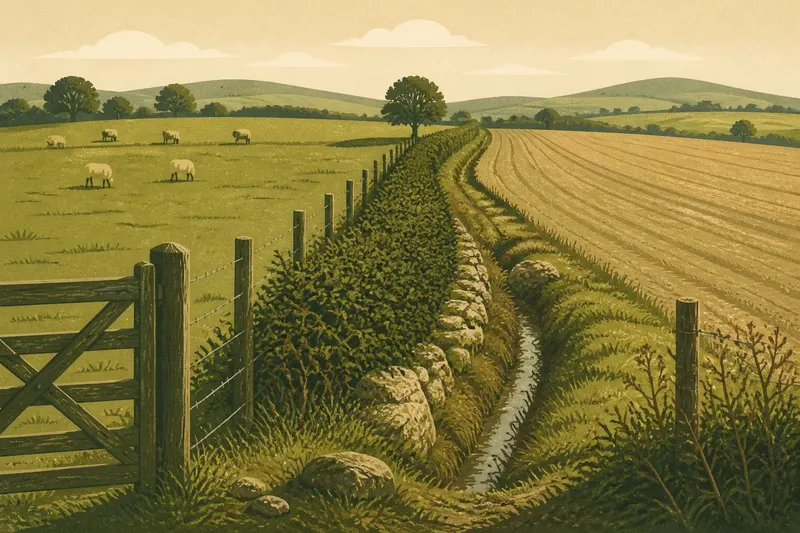
A field boundary can tell you what changes on the other side, but not always why. A straight ditch, a clipped hedge or a wire fence may mark a shift in drainage, grazing, access or ownership; reading the line carefully helps you notice the distinction without pretending it explains the whole field.
Field boundaries are working lines
In the countryside, a boundary is rarely just a mark on a map. It can hold stock, slow water, shelter crops, separate different kinds of ground, or make a route legible. Many boundaries do several of these jobs at once.
Start with what the line physically does. A bank topped with hawthorn is more substantial than a single strand of wire. A shallow ditch may carry water in wet weather, while a dry stone wall can divide grazing without blocking the view. These forms suggest practical needs, not a definitive account of who made the boundary or when.
Look at the ground on both sides as well as the boundary itself. A change from pasture to arable land, or from level ground to a damp hollow, may explain why a barrier is placed there. The line can be a response to the land rather than a simple division imposed upon it.
Shape and position offer different clues
A straight boundary often suggests deliberate laying out or later adjustment. It may follow a property division, a drainage line or the edge of a cultivated area. A winding hedge, by contrast, may follow older contours, a stream, or the edge of ground that was awkward to plough.
Neither shape settles the matter. A modern fence can follow an old, irregular boundary, and a straight line can run across land with a long history of use. Treat geometry as a prompt to look closer, not as a date stamp.
Position matters too. A hedge at the edge of a field can shelter livestock from wind and reduce exposure along an open slope. A boundary crossing the field may separate grazing from crops, or divide land with different soil or drainage. A line beside a track may define access as much as land use.
Follow the boundary’s relationship with nearby features. Does it meet a stream, continue along a lane, or stop where the slope changes? Connections can show how several practical divisions fit together. A line that appears arbitrary in isolation may make sense as part of a larger pattern.
Materials reveal what the line has to do
Material is one of the clearest clues to a boundary’s job. A hedge can provide shelter and habitat while marking an edge. Its density, gaps and height affect how well it contains animals, but they also reflect cutting, browsing and age.
Wire fencing is adaptable and can separate stock without taking much ground out of use. A fence with a hedge behind it may indicate that the living boundary alone no longer serves the practical need, or that protection is being maintained while the hedge grows. That reading is plausible, not certain: the fence may also have been added for a temporary purpose.
Walls and banks can make a stronger physical division. Their construction may respond to local stone, soil and the animals kept nearby. A ditch can mark an edge and carry runoff; a bank may keep water or livestock on one side. Where a ditch and bank sit together, notice which side is higher, but do not infer a legal boundary from that detail alone.
Say you come to a low bank with a patchy hedge and a narrow ditch on its lower side, beside a field that falls toward a stream. The bank and hedge may help retain stock while the ditch moves water downhill; the expected observable result is a boundary that both separates the field and channels runoff. A blocked ditch or a gap in the hedge would complicate that reading, which is precisely why the physical condition matters.
What can you infer from a field boundary?
Does a straight boundary mean the land was recently divided?
Not by itself. Straight lines can result from formal division, drainage or later fencing, while older lines may have been regularised. Look for supporting clues in neighbouring boundaries and the terrain.
Can a hedge show which side owns the land?
A hedge’s position does not establish ownership. Property records and local boundary information are more appropriate for that question, especially if a decision depends on it.
Why might a fence run beside a hedge?
The fence may contain animals where the hedge is thin, protect new growth, or serve a separate management need. Its presence tells you the boundary is being reinforced, but not necessarily when or why that choice was made.
Does a ditch always mark a field edge?
No. It may be primarily a drain, a stream channel or a feature that happens to coincide with a division. Its direction, connections and condition help indicate its function.
Read the whole line, not one clue
Useful interpretation comes from combining clues: form, material, position, slope, water and the land use on either side. If several point in the same direction, you have a stronger working explanation. If they conflict, the boundary may be serving more than one purpose or may have changed over time.
Season can make the evidence easier or harder to see. In winter, a bare hedge reveals its bank and gaps; after rain, a ditch’s flow may become apparent. In summer, dense growth can hide both. A brief view is still a brief view, not a complete record.
Also distinguish a visible division from permission to cross. Gates, stiles and established paths can indicate access arrangements, but a fence or hedge alone does not. Where access is unclear, use a mapped public route or check local rights-of-way information rather than treating an opening as an invitation.
For a useful field-boundary reading, note what changes at the line, what the boundary is made of, and how it connects to nearby ground. The shape can suggest the practical distinction; the land around it helps test that suggestion. A boundary is most informative when treated as evidence of use, not as a complete explanation.