A Rural Bus Timetable Is Not a Map
A rural bus timetable is not a map: learn to read stops, connections, walking gaps and return options before choosing a route between country places.
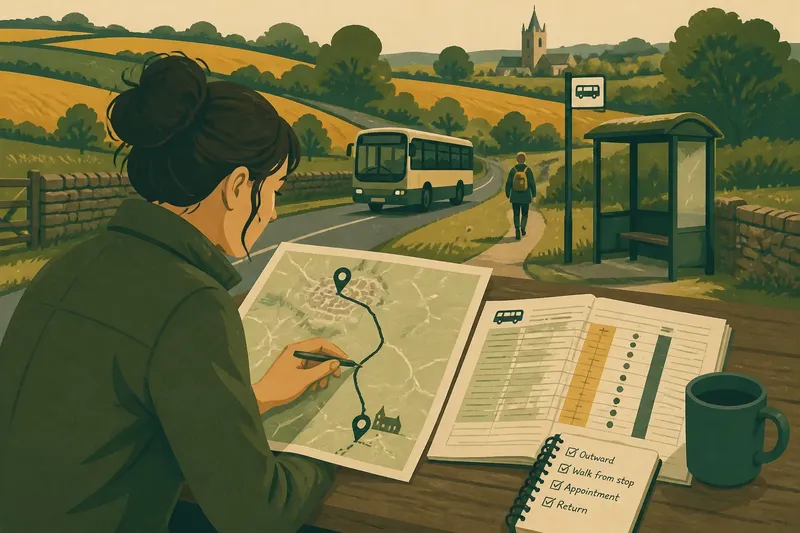
A rural bus timetable is not a map, and treating its route list as one can leave a short journey looking simpler than it is. A row of place names tells you which stops a service is scheduled to reach; it does not show how far apart those stops are, what lies between them, or whether the journey works in both directions at a useful time.
Read the timetable as one layer of a journey, then check the geography and the day around it. The useful question is not merely, “Does a bus serve both places?” It is, “Can I get from this exact starting point to that exact destination, at the time I need, and get back?”
Start with the actual places, not the route name
Write down where you will begin and where you need to arrive. Use the specific site—a farm entrance, village hall, clinic, shop or house—not just the names of two nearby settlements. A stop named after a village may sit at its edge, with the destination farther along a lane or on the other side of the parish.
Then find the stop names printed in the timetable. Names can be abbreviated, shared by more than one stop, or unfamiliar if a service uses a road junction rather than a village centre. Check a current map or the operator’s stop information to identify the actual boarding point, rather than assuming the most familiar place-name is the right one.
Say you need to reach a hall outside a small village for an afternoon meeting. If the timetable lists the village but the hall stands beyond it, mark both the bus stop and the hall on a map; the route list has answered where the bus goes, not whether the last part is a comfortable walk.
Begin with a pin for the destination, not a guess based on its name.
Read each journey as a separate trip
Timetables often present several journeys in a compact table, but a line of stops does not necessarily mean every bus serves every stop. Read across the columns and down the rows carefully. Pay attention to symbols, footnotes, day headings and notes such as “schooldays only” or “by request.” These can change which trip is available to you.
Check the day you intend to travel, including whether it is a school term, a weekend or a public holiday. Some rural services have different patterns on different days; others do not run every day. A timetable page may show all of these patterns together, which is efficient for printing and less kind to a hurried reader.
Next, note the time at the stop you will use, not just the departure time at the route’s first point. A bus that leaves the town centre at a convenient hour may reach your stop later. If times are shown in a sequence, follow the correct direction and service all the way to your boarding point and onward to your destination.
- Match the timetable’s day column to your travel date.
- Check that the selected journey calls at your boarding stop.
- Read any symbols and footnotes attached to that journey.
- Record the arrival time at the stop nearest your destination.
When a note is unclear, confirm it with the operator or the body that publishes the timetable before relying on it. The printed table is a schedule, not an invitation to infer missing details.
Check what the line between stops leaves out
A route list compresses distance into an order of names. It does not tell you whether the stop is beside a pavement, across a busy road, or at a junction with no obvious place to wait. A map adds geography, but even a map may not show the condition of a footpath, the presence of a gate, or whether a route is open to pedestrians.
Trace the walk from the stop to the place you need, and from your starting point to the stop. Look for roads, paths, crossings and barriers, rather than measuring the gap by how close the names appear on the page. A route that looks direct may follow a road with no safe walking space; a longer mapped path may be the more sensible connection.
Consider the terrain and the purpose of your journey. A walk that is manageable in daylight with a light bag may feel different after an appointment, in poor weather, or with someone who moves more slowly. These are not reasons to rule out a bus automatically; they are reasons to assess the actual connection instead of letting the stop names do the thinking.
Where access needs matter, seek specific information about the stop, vehicle and walking route. “Serves the village” does not answer whether the boarding point and the rest of the journey are suitable for a particular passenger.
Build the connection around the appointment
For a journey involving a change of bus, identify where the change happens and how much time the schedule allows. Two services that meet on a route diagram may not form a useful connection at the time you need. Check whether the second bus is a separate service, which stop it uses, and whether you must cross a road or walk to another part of the village.
Work backward from the time you need to arrive. Allow for the walk from the destination stop, and consider whether arriving just before an appointment leaves enough time to find the entrance or deal with a delay. A timetable can list a punctual-looking arrival without knowing what the day’s task requires.
Imagine a traveller heading to a morning appointment in a market town. The timetable shows a bus reaching the town before the appointment, but the clinic is outside the central stop’s immediate area; the traveller checks the walk, chooses an earlier suitable service, and confirms that the return bus leaves after the appointment is expected to finish. The observable result is a journey with a usable arrival and return window, rather than a pair of times that merely appear on the page.
For a change of service, verify both legs independently. Do not assume a connection is protected unless the operator explicitly says so.
Find out whether the return journey exists in practice
Look for the return service before setting out. A place may have a useful bus in one direction and a much less convenient one back. Compare the return departure with the likely end of your visit, including the time needed to walk from the destination to the stop.
Check whether the last useful bus runs on the same day pattern as the outward service. A timetable can make a round trip seem straightforward while a footnote removes the return option on a particular day. If the visit could overrun, consider what other transport is genuinely available rather than treating a later listed journey as an automatic fallback.
Also check where the return bus stops. A service may use a different stop on the opposite side of the road or at a different point in the settlement. The route order can make this easy to miss, especially when the table gives the same place-name for both directions.
Write down the return stop and time before you leave home.
Compare the timetable, map and operator information
Each source answers a different question. The timetable shows scheduled times and stopping patterns; a map shows spatial relationships and possible walking links; operator information can clarify service notices, stop locations and arrangements such as request stops. None of these sources alone describes the whole trip.
Check that the timetable is current and that any service alert applies to your route and travel day. A general route page can remain visible while a temporary notice changes where or when a bus runs. If information conflicts, use the operator’s current notice or contact channel to resolve the specific point rather than choosing the most convenient version.
For a stop marked “by request,” check the stated procedure and any deadline. Do not assume that waving from the roadside is enough, or that every bus serving the route will call there. The timetable or operator instructions should say what action is required.
Where local rules, access arrangements or the operator’s instructions determine what is possible, follow those details; they can vary by service and place.
Which details turn a route list into a usable journey?
Does the bus stop near the place I need?
Check the exact stop on a map and trace the remaining walk to the destination. A settlement name in the timetable does not establish that the stop is close to every building in it.
How can I tell whether a journey runs on my travel day?
Match the date to the timetable’s day headings and read the symbols and footnotes beside the selected trip. If a service notice changes the schedule, confirm that notice with the operator.
What should I check when I need to change buses?
Identify the transfer stop, the scheduled times for both legs and whether the boarding points are in the same place. Check the walking connection and do not presume that one service waits for another.
How do I know if I can get home afterward?
Find a return trip that runs on the same day, from the stop you can actually reach after your visit. Compare its departure with the likely finish time and the walk back to that stop.
Keep a small journey note
Once the trip makes sense, keep the details together: the outward stop and time, the destination stop, the walking link, any transfer, and the return option. Include the timetable date or source so you can tell later whether the information is still current.
A short note also makes gaps visible. If you cannot identify the right stop, verify the request-stop procedure, or find a return service, the journey is not yet clear enough to rely on without checking further. That is a useful finding, not a clerical failure.
A rural bus timetable is not a map, but the two can work together when you ask each to answer the question it is suited to. Before you travel, check the route, the day, the stop-to-destination walk and the return; the missing detail is often not another place-name, but the connection between them.